Saturday, 21 February 2015

ELSS - An expensive neglect

There are two kinds of people in the world – one for whom 14 Feb’15 meant Valentine’s Day and others for whom it means Indo-Pak World Cup Match. “ J

Now imagine a cricket team consisting of 11 Anil Kumbles only, or 11 VVS Laxman ! I hope you got the blunder that I am trying to point out – Imbalance. We need to balance out things in every sphere of life. Same goes for our financial planning in general and more so for our Tax Planning. We discussed in our last article, how Section 80(C) is the most availed and most extensive avenue of Tax Saving. It encompasses a total of 9 methods of Tax Saving within a limit of 1.5 lakhs.

But sadly for most of us Section 80(C) has become synonymous with Public Provident Fund (PPF), that too invested in one tranche when our respective companies ask for Tax Proofs. We hardly bother to explore other avenues, which may prove to be better or more relevant to us than PPF. One such product is Equity Linked Saving Scheme (ELSS). In plain terms it is a Mutual Fund which has a lock in period of three years, which means your money is not liquid for three years (ONLY). ELSS invest their corpus into stock markets.
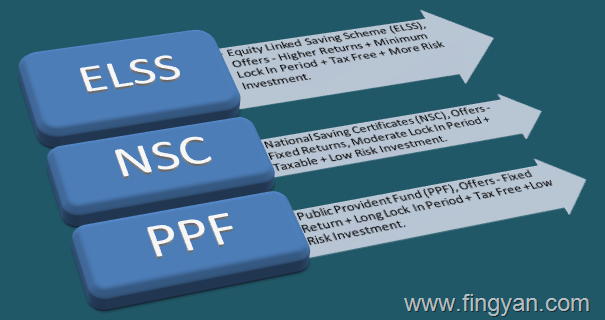
ELSS-vs-PPF.png

Now there are number of parameters on which financial planners analyse different financial avenues. I am producing my list of parameters –
  • Expected Returns
  • Risk
  • Liquidity
  • Tax Implications
  • Minimum ticket size
  • Ease of operating

Lets compare PPF and ELSS on these parameters one by one.

  1. Expected Returns – While PPF provides an almost constant rate of return, returns of ELSS are unpredictable being linked to equity markets. Definitely any investments into stock are not advisable for short term; ideal horizon for investments into stock markets is at least 3 years. There are umpteen studies that prove that stocks give 12%+ returns if your horizon is for more than 5 years. Returns from investments in stock markets tend to be proportionate with the horizon of investments. Taking in view that investments in PPF are blocked for 15 years, there is negligible probability that ELSS will give lesser returns than PPF if you keep yourself invested for that long period. Here is a comparative study

  1. Risk* – Theoretically there is risk imbibed in stock markets investments, but that risk is mitigated by investments in ELSS which are professionally managed by Fund Houses , which typically are backed by financial institutes of very high repute. Additionally high amount of regulations by govt and regulators ensure proper and prudent management of your money. As for PPF, as it is backed by govt , there is almost nil chance of default.
  2. Liquidity – this is one parameter where ELSS scores heavily over PPF. While money in PPF is blocked for 15 years, it is only blocked for 3 years in ELSS. That doesn’t mean you have to withdraw it compulsorily after 3 years, you can continue with your investments beyond 3 years as well. But you can’t withdraw it before 3 years.
  3. Tax implications – It is same for both PPF and ELSS. They are not taxed for the gains accumulated in them and both come under Section 80(C) i.e. investments in them  - along with other 80(C) avenues - is deductible (up to 1.5 lakhs) from income to calculate taxable income.
  4. Minimum ticket size – Its same in both. One can start investing in ELSS or PPF with 500 rupees only.
  5. Ease of operating – Nowadays one can open and operate PPF account linked to his bank saving account, as some banks offer PPF account as well. But in absence of the same, operating PPF becomes cumbersome as it is offered by post office and one has to brave all the “customer friendliness” of post office staff to even deposit money in that. In case of ELSS, they can be easily operated online by online credentials provided by respective Fund House. Even otherwise, if you invest through a middleman, he takes care of all your transactions and other requirements.
Though I have compared ELSS with PPF only, comparison remains almost same with other 80(C) avenues like National Saving Certificate (NSC), Tax Saving Fixed Deposits (FDs) , as these avenues are similar to PPF on above set of parameters.

To summarise, PPF and ELSS have their own respective set of pros and cons. One has to decide which set of pros and cons attract him or her. But as any balanced portfolio, your 80(C) investments should also have exposure to ELSS and should not be totally skewed towards traditional tools like PPF or NSC or FDs.

*Risk is central force to be considered while investing. more about it here and here


If you don’t want to miss any of our articles please like our facebook page here and follow us on twitter

Thursday, 15 January 2015

A Starter's Guide to Better Stock Picking


Earnings Per Share

A common indicator and approach to stock market investing is the looking at the profits earned by the company. We generally tend to compare it over a period of time that includes year on year, quarter on quarter etc. But is it right? Is it correct? Are we on the right track? Well, the answer is yes and no. No doubt the profits earned by the company are a way to gauge its performance over a period of time but it never gives a complete picture. While analyzing and comparing the profits of company, we should also take note of the industry performance and performance of the peers /competitors in the strategic group. For the purpose of simplicity, strategic group are companies having similar nature of businesses. Take for example, Tata Motors per se can be compared with Maruti Suzuki, but the Performance of its Jaguar Land Rover division would need to be excluded.
Now that is just the beginning. The true indicator of performance and shareholder value creation is the Earnings per share (EPS). It is per se a representative of the value generated by the company’s operations to its common stockholders. The company may be incurring profits, but the capital structure may not allow the company to pass on the earnings to its shareholders. For the purpose of simplicity, the capital structure represents the different sources of funds the company has used to fund its operations / assets.  In its crude form, capital structure identifies the debt and equity structure of the company. Some companies can have complex capital structure that would involve hybrid securities, e-sops, preference shares etc.
Apart from Earnings per share, the Next things that come to the picture are different financial ratios like debt-equity, asset turnover ratio, profitability ratios etc. A quick comparison with industry/peers and over a period of time shall give a clear picture on whether to invest in a company or otherwise continue staying or not.
However, at this point it is important first to understand the underlying principles of EPS
EPS, in simple form is referred as the ratio of earnings (profit after tax) generated by the company to the no. of shares of a company in the market.

A common mistake in calculating the earnings per share is that we generally tend to divide the earnings with the existing no. of shareholders on a given date. This is however, not correct. Changes in the equity structure of the company over a period of time need to be discounted with. It is done by calculating the weighted average no. of shares.  Further, companies with complex capital structure need to declare diluted earnings per share. In case, an investor sees both Basic Earnings per share and diluted earnings per share, it is imperative that he/she uses the diluted earnings per share as a metric to analyze and compare the performance.

The above guidelines, however do not take cognizance of the accounting adjustments that companies do to show better ratios and higher EPS. In accounting terminology, the same is known as Earnings management and is legal as per law. This will be when the financial statements are stated and books of accounts are adjusted for various accounting policies within the frameworks prescribed as per Standards. This is legal and is unlike the case in Satyam, wherein the accounts were manipulated and fake assets were shown. These accounting policies are always declared in the notes to accounts and are sometimes discussed in the management discussion section of the financial reports.
To summarize, in order to gauge a company’s performance and deciding whether to invest or not is dependent on many factors. It includes understanding and comparing various financial ratios and comparing the same with its peers. The most important indicator however is Earnings per share which is value created for shareholders. EPS calculation is complex and requires and understanding of Companies capital structure and discounting for its accounting policies.
The next sections shall cover more on Earnings per share followed by the cost of capital of the company and the relation to Earnings per share.


        Guest Author
        Utkarsh Khanna, MBA (Finance) , 
        Indian Institute of Management Lucknow.
...


Income Tax Savings - A Checklist


January for most of us is an "eye opening" month. The month that wakes up to the one of the most hated realities of our finances - "Income-Tax". We keep running for compiling all the data and documents that needs to be submitted to accounts dept of our respective companies to reduce our tax-ability . But a more prudent approach to TAX rather Tax Saving should start at the beginning of the Financial Year itself. Initial stage involves understanding the available Tax Saving options and then planning your investments and moneyflow in a manner that facilitates maximum tax saving or should we say minimum tax outflow.To cite an example, if you want to invest in Mutual Funds, investing in Equity linked Service Schemes will help you in reduction of Taxable Income in addition to all the benefits of investing in Mutual Funds. 

Here is a small checklist for reference before you start compiling documents to be submitted to your accounts department

1. Section 80 (CCE) – “The Versatile”
 Arguably the most popular instrument,it can reduce taxable income by upto 1.5Lakh per          annum by  investing in the following instruments -
    Employee Provident Fund (self contribution)
    Public Provident Fund (PPF)
    Home Loan Principal amount
    National Saving Certificate (NSC)
    Tax Saving Fixed Deposits (FDs)
    Life Insurance Premium and Unit Linked Insurance Plans
    Equity linked Service Schemes (ELSS)

2. 80 CCC – Contribution towards notified Pension Schemes
3. 80 CCD - Contribution towards National Pension Scheme
4. 80 (D) – The ‘Healthy’ Tax Saving
                 Limit – Rs. 40 thousands
                 Instruments available –
                 Medical insurance (self and dependent family members and parents )
                 Medical Check up (self and dependent family members and parents )
5. 80 DD – ‘Charity begins at home Part-1 ‘
                 Limit – Rs. 1 lakh
                 Instruments – Medical expenditure on dependents with partial or severe disability
6. 80 DDB – ‘Charity begins at home Part-2 ‘
                 Limit – Rs. 60 thousands
                 Instruments – Medical expenditure on dependents with notified diseases
7. 80 E – ‘Education with Tax Saving ‘
                 Limit – None
                 Instruments - Interest paid on Education Loan
8. 80 EE – ‘My first Home’
                 Limit – Rs 1 lakhs
                 Instruments – Interest paid on loan for first time home buyer
9. 80 U – ‘ Enability Tax Saving ‘
                 Limit – Rs 1 lakh
                 Instrument – Medical expenditure
In addition to above mentioned instruments, tools like Hindu Undivided Family (HUF) can also be put into use for more efficient and effective Tax Saving. But more on it in coming articles.